How to Figure Metal Roofing Materials
Download as a printer friendly PDF file, or continue down for the complete guide to figuring metal roofing materials. This guide explains how to figure materials for both metal shingles and metal roofing panels.
Remember that no guide can cover all circumstances, so if you have a situation where you're not sure how to figure your metal roof, just give us a call, or send us an email. We'll be glad to help you.
Step 1: Measure & Sketch
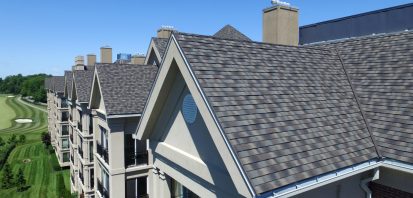
The first step in figuring your metal roofing is to measure your roof, then make a sketch of it, complete with all roof measurements. Take the house below as an example:
Photos are also helpful if available. If birds eye views are available for your house from Google Maps or a similar online service, they may help you to draw the sketch. It's not critical that the sketch be to scale, as long as the measurements are accurate.
Include the pitches (steepness) of the roof sections if available.
Note: From here you can just present us with this drawing and the product you want figured, and we’ll do the rest, figuring both the panels and trim you need. We can often enter it into our specialized 3D software to provide you with the most accurate information possible. Be sure to include the completed form on page 7 of the printer friendly PDF file. Or you can continue down to learn how to figure it yourself.
Step 2: Rectangles & Triangles
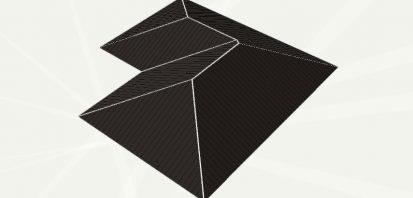
The second step is to break it into rectangles and triangles like this:
Note: You can but don't have to actually redraw the sections as shown, instead just mentally break the first drawing into rectangles and triangles, and figure them accordingly.
Step 3: Figuring Metal Shingles or Panels
Metal shingles and metal panels are figured differently. Shingles are figured by the square foot, as they are smaller sections, whereas panels are cut figured by the panel, as each are cut to length, and run from ridge to eave.
A. Metal Shingles - (For panels, skip down to section B)
| Rectangles | Triangles |
In this example, 19' x 16' = |
In this example, 19' x 10' / 2 = |
| Add the square footage up for all sections and add them together. Add approximately 10% for waste. | |
B. Metal Panels - (For shingles, go back up to section A)
| Rectangles | Triangles |
In this example, for a 3’ wide panel: |
(Or ask about an Excel spreadsheet where you plug in the panel length, base, and panel width to find out how much shorter each panel needs to be.) Or if you don’t mind a little waste, divide the width (10’ in this case) by the width of the panel you are using to get the number of panels. The length is as needed. If you did it this way for the above example, for a 3’ wide panel you would need 4pc at 19' long for this section. |
| Make a list showing the quantity needed of each length. We recommend that you add 2 panels of the longest length just in case. | |
Step 4: Figuring Trim
Add up the total footage of each type of trim; ridge, gable, eave, valley, transition, endwall, sidewall, etc and put it in a list like this: |
|
| It is recommended that you add about 10% to each trim quantity for waste, trim laps, etc… | |
Just present us with this list and we’ll take it from there, carefully figuring all the correct pieces you need. Be sure to include the completed form on page 7. Be sure to include the completed form on page 7 of the printer friendly PDF file. This same form includes a blank list for including panel/shingle quantities, trim amounts, etc.
|
|
![]() |

Multiple the length by the height to find the square footage of each rectangular section.
Multiple the length by the height, then divide by 2 to find the square footage of each triangular section.